
Step by step toward greater sustainability
10 Dec 2025
Linde Material Handling publishes updated sustainability report for 2024
For companies, becoming more sustainable is a process that requires perseverance, creativity, foresight and courage. Each year, Linde Material Handling (MH) publishes a sustainability report that details its progress in a wide range of areas, including the environment, health, occupational safety, social engagement, and products and solutions. The updated, comprehensive online publication for 2024 is now available. It shows the progress the intralogistics specialist has made in reducing greenhouse gas emissions. The increased use of electric commercial vehicles is expected to further improve these results. Beginning in early 2026, two electric trucks will transport forklift counterweights 35 kilometers from the foundry to the assembly plant in Aschaffenburg. Additionally, Central Services will utilize ten more transport vehicles, which will contribute significantly to the decarbonization of journeys within and between the sites in the Aschaffenburg region.
Direct and indirect greenhouse gas (GHG) emissions, Scope 1 and 2, respectively, are among the key figures listed in the report and were reduced in 2024. “We have achieved this, for example, through a high proportion of ‘green electricity’, but also through the use of waste heat and energy-saving measures in infrastructure and production,” explains Bernhard van der Westhuizen, Head of HSE Sales & Service for Linde MH. From 2026, the use of new electric trucks and vans will have a positive impact on this figure and contribute to achieving the short-term climate target of reducing Scope 1 and 2 emissions by 4.7 percent annually by 2030 compared with the base year 2021. By 2050 at the latest, the amount of GHG emissions along the entire value chain (Scope 1, 2, and 3) is to be reduced to net zero.
The new 42-ton tractor units, which have a battery capacity of 600 kWh and a range of 500 km, as well as the ten additional light commercial vehicles, which weigh up to 3.5 tons, and the charging infrastructure were funded under the German Federal Ministry of Digital and Transport’s guideline on the promotion of light and heavy commercial vehicles with alternative, climate-friendly drive systems (KsNI). Part of this funding comes from the EU’s German Recovery and Resilience Plan (GRRP). “The procurement of these vehicles is an important step in the electrification of our internal logistics,” emphasizes Franz Huber, Project Manager Energy Solutions at Linde MH. With its new electric vehicle fleet, the company aims to save around 180 tons of CO2 per year. The heavy trucks will be used for shuttle traffic between the foundry and the assembly plant, and the electric transporters will help make logistics between regional locations emission-free. For instance, they deliver canteen supplies.
.
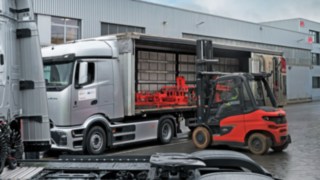
The procurement of the new electric vehicle fleet is an important step in the electrification of the internal logistics of Linde Material Handling.
The procurement of the new electric vehicle fleet is an important step in the electrification of the internal logistics of Linde Material Handling.
Small improvements add up
Further improvements were seen in sustainability indicators regarding the coverage of the international environmental management standard ISO 14001. The percentage of plants and sites within the Linde MH sales and service organization that meet the requirements of this recognized environmental management standard increased from 94 percent in 2023 to 99 percent. Life cycle assessments (LCAs) are an integral part of this standard, for instance. LCAs systematically analyze the potential environmental impacts and energy balance of products from raw material extraction and manufacturing through the use phase, and finally, disposal or recycling at the end of the life cycle. More than 20 years ago, Linde MH partnered with the Fraunhofer Institute for Building Physics to develop a scientific methodology for comprehensively assessing the environmental impact of its forklift trucks and warehouse equipment. The company then conducted life cycle assessments for its key product groups. Since then, the methodology has continuously been refined and professionalized. Today, these LCAs are based on ISO standards 14040 and 14044. They already exist for many of Linde’s industrial truck series. The electric forklifts with a load capacity of 1.0 to 2.0 tons, introduced earlier this year, were the first to include an LCA at market launch.
The sustainability report also includes preliminary results from the strategic partnership with the battery recycling company Li-Cycle Holdings Corp. (known as Glencore Battery Recycling since August this year), which has been in place since 2023. Around 15.8 tons of lithium-ion battery modules, or 442 lithium-ion batteries returned to Linde MH in 2024, underwent the recycling process. The recovered materials are subsequently processed into resources that can be used to manufacture new batteries.
Beginning in early 2026, two electric trucks will transport forklift counterweights from the foundry to the assembly plant of Linde Material Handling.
Beginning in early 2026, two electric trucks will transport forklift counterweights from the foundry to the assembly plant of Linde Material Handling.
“In an economically challenging environment in particular, it is especially important to combine improvements in efficiency and cost-effectiveness with sustainability benefits,” adds van der Westhuizen. In recent years, Linde MH has consistently refined its product development strategy by integrating sustainability aspects into the initial design phase, as well as into the production process. Aspects such as occupational health and safety have also been further enhanced.