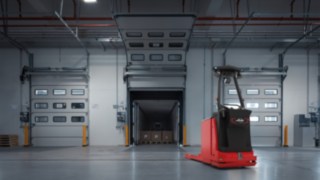
Truck loading docks are one of the most important hubs along the entire supply chain. All the typical challenges of modern intralogistics, like a high throughput, tight time windows, and complex processes, are encountered here. At the same time, there is a shortage of qualified personnel. Nearly two-thirds of logistics companies are having trouble filling open positions, meaning the shortage of skilled workers has become a structural problem. Added to this is an increased risk of accidents in areas where industrial trucks, people, and delivery trucks are all present at the same time.
Automated truck loading systems (ATLS) handle the loading and unloading of trucks and trailers with little or no manual intervention. Traditional loading and unloading systems are stationary and use conveyor technology, telescopic forks, or skate systems to unload the cargo in one or more passes. They require a fixed infrastructure in the loading zone, and in some cases also modifications to the trailer, which incurs high investment costs and limits the flexible, hybrid use of loading areas.
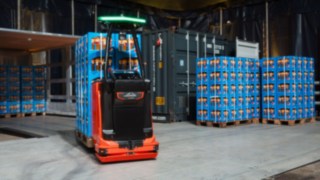
The T-MATIC core from Linde Material Handling takes a different approach. As an automated guided vehicle (AGV), the pallet truck moves the pallets one by one into the trailer, taking over the last, previously manual step in the incoming and outgoing goods area . No changes to the ramp, trailer or existing infrastructure are needed.
Meaning the loading ramp is still available for manual use, while the loading process can be automated in stages. Thanks to the T-MATIC core, dependence on hard-to-find skilled personnel is reduced, the risk of accidents is lowered, and a stable throughput is ensured even as transport volumes increase.
Autonomous Pallet Truck at the Loading Dock
As an autonomous pallet truck, the T-MATIC core loads trucks without a driver and with no stationary infrastructure on the loading ramp. It can be used on any loading dock, so you don’t have to compromise on any manual or conventional capacity. The video below shows how this works in practice.
The Benefits of Automated Truck Loading and Unloading
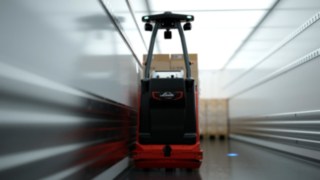
Automated truck loading is not dependent on shift patterns, daily fluctuations, or staff availability. This makes it easier to plan time slots and, thanks to consistent, repeatable workflows, reduces the risk of damage to the goods during transport. The T-MATIC core combines these advantages with minimal upheaval for integration into your warehouse. Since neither the trailer, the loading ramp, nor the stationary infrastructure requires any technical modifications, the automated guided vehicle can be integrated into existing loading processes without fundamentally altering the physical environment.
Automated Truck Loading and Unloading in Detail
The T-MATIC core loads and unloads pallets weighing up to 1,500 kilograms and moves them autonomously and precisely between the supply zone and truck loading area, and vice-versa. However, it truly comes into its own when the pallet quality can be reliably predicted. The best example of this is in the outgoing goods area, where standardized pallets ensure maximum process reliability and reproducible workflows.
High Throughput: 30 Euro Pallets in Around 35 minutes
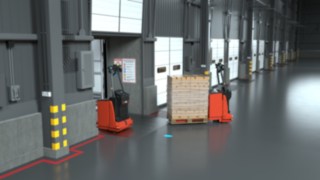
Two T-MATIC core trucks operating in parallel can load 30 Euro pallets in about 35 minutes. Since the trucks operate fully autonomously, one warehouse worker alone can monitor loading at up to five loading docks simultaneously. The fleet control software coordinates the process by controlling the trucks’ movements, managing the flow of materials, handling traffic control, and automatically assigning transport orders. The system can be expanded gradually to cover multiple docks, allowing you to scale the automation solution to best suit your needs.
Integration into Existing Infrastructure
As an automated guided vehicle, the T-MATIC core is designed for use in existing logistics environments. Since the sensors, safety features, and localization system are built into the truck, there is no need for any extra equipment to be installed on the loading ramp or trailer, nor for stationary protective devices. The T-MATIC core can therefore load and unload standard trailers from forwarding partners without the need for any prior technical modifications. This makes the solution particularly flexible because it is not limited to a specially equipped fleet of trailers. Changes in material flows are made using the software, allowing routes and process flows to be configured digitally and adjusted as needed without interfering with the existing infrastructure.
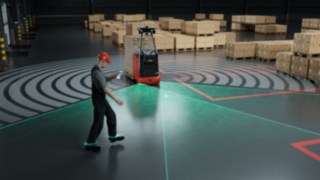
Increased Safety in the Dock Area
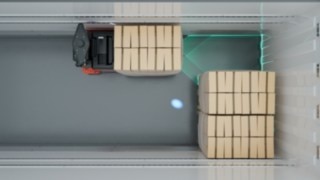
In practice, safe loading and unloading of trucks usually fails due to two hazards: drops at the edge of the ramp and when driving over loading ramps, or collisions between industrial trucks and people. The T-MATIC core’s four safety scanners monitor the entire travel area, while three 3D cameras detect obstacles in the truck’s path. If it encounters an obstacle, the truck automatically calculates an alternative route (provided there is enough space) and then rejoins the planned route. Integrated cliff detection monitors the loading edge and prevents the truck from accidentally driving off the ramp. BlueSpot warning lights, status indicators, and emergency stop devices complete the safety concept.
Navigation Using 3D Visual SLAM
The T-MATIC core uses 3D Visual SLAM technology for navigation outside the trailer. It continuously monitors its surroundings and determines its position in real time. Reflectors, floor markings, or other stationary orientation aids are not required. Visual SLAM is one of the established navigation methods for driverless transport systems and enables flexible navigation in dynamic environments. When the truck enters the trailer, it automatically switches to scanner-based localization. The safety scanners use the inner contour of the trailer as a reference to determine the truck’s position. No additional lighting or modifications to the trailer are needed.
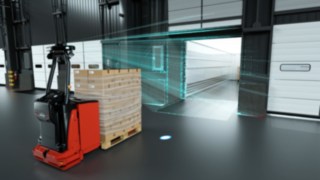
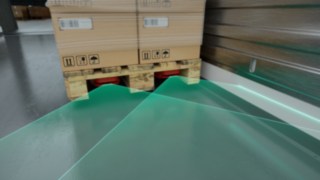
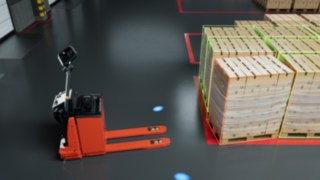
Reliable Pallet Detection
The pallet is detected using a built-in 3D camera, which creates a 3D model of the pallet and determines its position and the optimal way to approach it in real time. The system compensates for typical deviations resulting from manual placement of the pallets and handles pallets with positional deviations of up to 15 degrees, as well as crosswise deviations of 20 centimeters and lengthwise deviations of 10 centimeters. As a result, the T-MATIC core operates reliably under normal operating conditions, even among a variety of traffic.
Power Supply and Running Time
The T-MATIC core automated pallet truck is equipped with a 12-kWh lithium-ion battery and is designed for operating times of more than eight hours. When it needs to recharge, the truck automatically finds its way to the charging station. Charging from 20 to 80 percent takes about 1.8 to 2.8 hours.
Want to Be a Pioneer in Automated Truck Loading and Unloading?
The T-MATIC core is currently available to early adopters in the EMEA region. Customers who wish to actively contribute to the further development of the solution will benefit from a first-mover advantage.
As part of a proof of concept, you can test the T-MATIC core under real-world operating conditions and determine the payback period for your specific loading process.
From Picking up to Setting Down: How Automated Truck Loading Works
Step 1: Pallet Pickup in the Supply Zone
A 3D pallet camera captures each pallet and creates a 3D image. The pallet truck detects deviations from the ideal position and automatically corrects them. The optimal approach is calculated in real time.
Step 2: Autonomous Travel to the Loading Dock
The truck navigates using infrastructure-free Visual SLAM. Neither reflectors nor floor markings are required. Three 3D cameras for obstacle detection and four safety scanners monitor the truck’s path and reliably protect people working among mixed traffic.
Step 3: Transition to the Loading Area
At the loading edge, the truck switches from camera-based to scanner-based localization. The safety scanners use the fixed contour of the trailer as a reference. Additional lighting in the trailer is not required.
Step 4: Precise Pallet Positioning in the Trailer
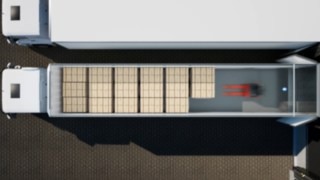
The pallets are positioned flush with the sidewall or the adjacent pallet at the front and sides so that three pallets fit in a row. Only the last row of pallets is added manually.
Step 5: Return and Repetition
After loading the pallets, the T-MATIC core returns to the supply zone and starts the process over from the beginning. When it’s time to recharge, the truck independently makes its way to the charging station.
How Automated Truck Unloading Works
During automated truck unloading, the process takes place in reverse order. The T-MATIC core drives into the docked trailer, determines its position based on the inner contour, picks up the front row of pallets, and deposits them in the supply zone. The requirements are the same as those for loading: undamaged Euro pallets with minimal overhang and fork insert areas free of plastic wrap. The load can be wrapped in plastic at the top to stabilize it and reduce any overhang.
Where the T-MATIC Core Shines
The T-MATIC core is designed for companies with high pallet volumes and repetitive loading processes. It is particularly well-suited for two or three-shift operations with multiple loading docks. Typical areas of application include logistics centers, the food industry, food retail, the consumer goods industry, and the pharmaceutical industry.
Ideal Operating Conditions
Successful implementation of the T-MATIC core requires a few key conditions that optimally support the automated loading process.
Standardized pallets
The T-MATIC core is designed for short-side pickup of EPAL-1 pallets (Euro pallets). The pallets should be undamaged and loaded as evenly as possible. They must be free of plastic wrap at the bottom where the forks enter. The load can be wrapped in plastic at the top, however, to make it more stable and minimize any overhang. Minor overhangs can be compensated for by the integrated sensors. These requirements comply with the pallet standards commonly used in many European logistics and manufacturing companies.
Standard trailer with rear loading
The T-MATIC core is compatible with standard semi-trailers, swap bodies, and truck trailers. No modifications or additions to the trailer are needed. The only requirement is a solid inner contour up to 25 cm in height, which the safety scanners can use as a reference for localization.
Software and System Integration
The T-MATIC core is managed via a browser-based user interface that can be accessed from any device on the company network. No additional operating hardware is required, which makes it easy to integrate administration into existing operational and shift structures.
The associated fleet control software coordinates truck movements, assigns transport orders, and manages the flow of materials and traffic involving multiple trucks. This makes it possible to control automated loading processes in parallel at multiple loading docks.
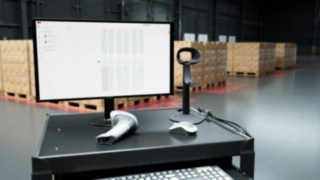
The VDA 5050 communication standard and open interfaces can be used to integrate the T-MATIC core into existing automation solutions like warehouse management systems (WMS), warehouse control systems (WCS), material flow and dock management systems, as well as other higher-level IT and automation systems. It is also possible to integrate gate control systems, allowing for end-to-end automation of the material flow from the supply area all the way to the trailer.
The T-MATIC core therefore digitally orchestrates the entire loading process from automatic order generation and gate assignment to loading the trailer for increased transparency, process reliability, and efficiency in the outgoing goods area. In this way, automated truck loading becomes part of a seamless automated warehouse .
FAQ—Frequently Asked Questions About Automated Truck Loading and Unloading
What is an automated truck loading system (ATLS)?
An ATLS (automated truck loading system) automates the loading and unloading of trucks, either fully or partly, without the use of manual forklift trucks. There are two types: stationary truck loading systems use conveyor technology inside the trailer, telescopic forks, or skate systems to push the entire load into the truck in a single pass. Despite the fact these systems work quickly, they require modifications to the loading zone and, in some cases, to the trailer. Automated guided vehicles (AGVs) such as the T-MATIC core from Linde Material Handling load the pallets into the trailer one at a time. Although this takes longer when compared with stationary systems, it does not require any additional equipment and therefore also works with standard, unmodified trailers from freight forwarding partners. The dock can still be used for manual loading and unloading between automated processes.
What is the T-MATIC core?
The T-MATIC core is an automated pallet truck from Linde Material Handling. It was developed specifically for automated truck loading and unloading at loading docks, one of the last purely manual steps in the incoming and outgoing goods area up to now. The truck boasts a load capacity of 1,500 kilograms and is based on a tried-and-tested manual pallet truck from the Linde portfolio. It has been equipped with sensors, a navigation system, and safety technology for automated operation, allowing it to join the ranks of automated trucks from Linde MH. It benefits from the best of both worlds, combining the robustness of proven Linde technology with state-of-the-art automation technology.
Is the T-MATIC core an automated truck loading system?
The T-MATIC core is an automated truck loading system based on an autonomous pallet truck rather than a stationary installation. Unlike fixed automated truck loading systems, no equipment needs to be added to the ramp or trailer, so it can be used flexibly at various loading docks. Sensors, navigation, and safety technology are fully integrated into the truck, which means the loading dock can still be used for manual operation as well.
Can the T-MATIC core also be used for automated truck unloading?
Yes. In addition to automatically loading trucks, the T-MATIC core can also unload them. The prerequisite is that the incoming pallets meet the same requirements as those for loading: EPAL-1 pallets, undamaged, free of plastic wrap in the fork area, and loaded as evenly as possible. Since this standardization can be reliably ensured for a company’s own pallets in the outgoing goods area but is not always the case for incoming third-party trucks, the core application of the truck is automated truck loading.
How does automated truck loading and unloading work with the T-MATIC core?
The process consists of five stages. First, the 3D pallet camera scans the pallet in the supply zone and automatically compensates for positional deviations. The T-MATIC core then drives autonomously to the loading dock, navigating using 3D Visual SLAM and avoiding obstacles in mixed traffic. At the loading edge, it switches from camera-based to scanner-based localization. In the trailer, it positions the pallets precisely according to the loading pattern provided by the fleet management software. After loading the pallets, the pallet truck returns to the supply zone and starts again. When unloading pallets, the process begins in the trailer with the T-MATIC core driving into the docked trailer, picking up the pallets, and depositing them in the supply zone.
How does the T-MATIC core differ from loading trucks with forklifts?
For conventional truck loading using forklifts, one qualified driver is required per loading dock to manually maneuver the forklift. The T-MATIC core operates as an autonomous pallet truck entirely without a driver, allowing a single warehouse worker to monitor loading at up to five docks simultaneously.
Are any structural modifications needed to the ramp or trailer?
No. All of the T-MATIC core’s sensor, safety, and localization technology is fully integrated into the pallet truck. There is no need for any fixed safety devices at the dock. Standard trailer models with rear loading are sufficient. The only requirement inside the trailer is a solid inner contour up to 25 cm in height, which the safety scanners use as a reference point. This allows the T-MATIC core to be integrated into existing trailer fleets, whether they belong to the company itself or to freight forwarding partners.
How quickly does the T-MATIC core load a truck?
Two T-MATIC core trucks can load 30 EPAL-1 pallets in about 35 minutes. A single truck takes about 60 to 65 minutes to complete the same task. Stationary loading systems are faster per trailer, but they are permanent installations at the loading ramp and require structural modifications. In contrast, the T-MATIC core can be used at multiple docks simultaneously, with the fleet management software handling the routes, traffic control, and order assignment as needed. The last row of pallets is currently loaded manually.
Which pallets and trailers are compatible with the T-MATIC core?
The pallet truck is intended for use with undamaged EPAL-1 pallets (Euro pallets) with the short side facing forward. They must be loaded as uniformly as possible with minimal overhang and be free of plastic wrap at the bottom where the forks enter. The load can be wrapped in plastic at the top, however, to make it more stable. These specifications are consistent with the pallet standard that is predominant in Europe. Standard trailers with rear loading, such as semi-trailers, swap bodies, or truck trailers, are compatible without requiring any structural modifications. One prerequisite is that the trailer should have a solid inner contour up to 25 cm in height so that the safety scanners can reliably determine the truck’s position inside the trailer.
How safe is operation in mixed traffic made up of people and manual forklift trucks?
The T-MATIC core uses four Performance Level d safety scanners that provide 360° coverage of the truck’s surroundings. Three additional 3D cameras detect obstacles and enable the truck to navigate around them autonomously. Cliff detection protects the truck from falling off ramps and the dock edge. In addition, the Linde BlueSpot, status LEDs, and acoustic warning signals ensure visibility in mixed-traffic environments. Two emergency stop switches allow for immediate intervention if required. The interaction of these systems makes operation in mixed traffic particularly safe.
Can the loading dock still be used manually?
Yes. Since all of the T-MATIC core’s safety and sensor technology is integrated into the truck itself, no stationary equipment is required at the dock, so manual forklift operations can continue as normal. This hybrid approach is a deliberate part of the concept. Special cases, peak loads, or trailers that do not meet the standard requirements can be loaded and unloaded manually at any time, while the T-MATIC core operates in parallel at other docks.
For which companies and industries is the T-MATIC core suitable?
The T-MATIC core is designed for companies with high pallet volumes operating on a two or three-shift schedule that want to optimize their truck loading processes. Typical areas of application include manufacturing companies, logistics centers, the food industry, and food retail, as well as the consumer goods and pharmaceutical industries, provided they have a process environment with standardized EPAL-1 pallets and rear loading into standard trailers. The battery system, which offers over eight hours of operation and autonomous charging, makes the pallet truck the ideal choice for high-volume, multi-shift operations during the day.