Inbound and Outbound Logistics
Loading Dock Operations: Truck Loading and Unloading
At certain times of day, the incoming and outgoing goods areas are hives of activity. Trucks pull up to the loading docks and swap bodies and containers are docked for unloading or loading. Pallets and other load carriers must be accepted, inspected, and forwarded, or prepared for shipment quickly. The term “inbound logistics” refers to all the processes incoming goods undergo, from acceptance and inspection through recording to preparation for storage or further processing. Outbound logistics, on the other hand, includes the preparation, inspection, and loading of outgoing goods for onward transport. Both areas serve as key interfaces between warehousing and transportation.
In these areas in particular, workflows must be coordinated seamlessly to make optimal use of tight time frames. Linde MH offers a wide range of industrial trucks designed specifically for the demanding tasks involved in inbound and outbound logistics. These include pallet trucks for transporting pallets at floor level, pallet stackers for flexible lifting and stacking, and double-deck pallet stackers for simultaneously handling two load carriers. Counterbalanced forklift trucks are also available for truck loading and unloading at the loading dock and for side loading.

Specialists in Inbound and Outbound Logistics: The Right Solution for Every Application
Selecting the best truck requires a careful analysis of your individual requirements and the on-site conditions. Factors such as the length of transport routes, the frequency of incoming and outgoing shipments, the type and weight of the goods to be moved, and the physical warehouse layout play a decisive role here.
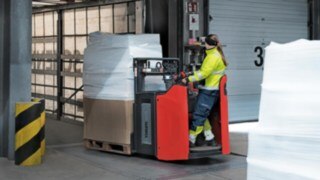
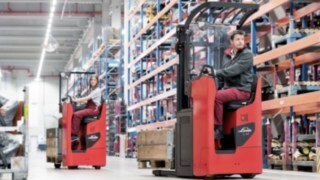
For this reason, Linde MH’s product range features highly diverse and adaptable options, ranging from classic pedestrian models to more powerful variants designed for more intensive use. This includes:
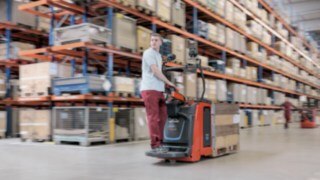
Trucks with a Folding Stand-on Platform


Trucks with a Fixed Stand-on Platform


Trucks with a Driver’s Seat


Counterbalanced Forklift Trucks: Allrounders at Loading Docks and Outdoors
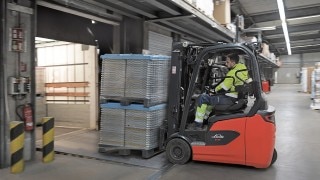
Counterbalanced forklift trucks from Linde MH are truly multitalented when it comes to loading and unloading. They can take on traditional loading dock operations as well as loading trucks from the side and can reliably handle even heavy or bulky loads. They also perform well over longer transport distances between trucks and warehouses or carrying out demanding loading and unloading tasks outdoors. Linde Material Handling has the right truck whatever your requirement in the load capacity range from 1 to 18 metric tons. You can choose from electric forklift trucks with a lithium-ion or lead-acid battery, or diesel and gas forklift trucks.


Automated Trucks: Loading Without a Driver, Around the Clock
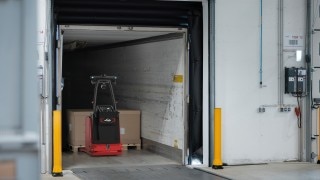
T-MATIC core: Autonomous Loading at the Loading Dock
The automated T-MATIC core pallet truck from Linde Material Handling takes over the loading and unloading of trucks, moving along the loading dock completely autonomously and relieving warehouse staff of repetitive loading tasks. With a load capacity of 1,500 kilograms and an operating time of over eight hours thanks to its high-performance lithium-ion battery, the truck is ideal for multi-shift operations. Two T-MATIC core pallet trucks working together can load up to 30 Euro pallets in around 35 minutes; only the last row of pallets needs to be added manually. As a result, companies with high volumes of goods benefit from predictable turnaround times, shorter loading times, and a significant increase in productivity in outbound logistics.
Beyond the trucks themselves, Linde MH also offers a comprehensive range of assistance systems and safety features, so users can find a solution to suit their incoming and outgoing goods processes that perfectly combines efficiency, safety , ergonomics, and cost-effectiveness.
Challenges and Solutions at the Loading Dock
Repeated ramp crossings, tight turns, and frequent starts and stops take a toll on truck components such as the chassis, tires, and power unit. For drivers, constantly driving over loading ramps causes severe vibrations that put a strain on their backs and joints. Added to this are cramped conditions and heavy traffic, which require constant concentration and can pose a risk to loading dock safety. Linde Material Handling has the right solutions for these challenges in incoming and outgoing goods departments.
Physical Strain on the Driver
Protection Against Vibrations
As drivers in goods receiving and shipping areas have to constantly maneuver over loading ramps, they are exposed to particularly severe vibrations. Over time, this can lead to health problems, such as back pain or joint problems. Linde MH’s solution is its SP/AP series of pallet trucks, pallet stackers, and double-deck pallet stackers, which have been ergonomically engineered specifically for intensive use in incoming and outgoing goods areas. The counterbalanced forklift trucks from Linde Material Handling are also designed with ergonomics in mind. The mast, axles, and chassis are vibration-free as standard to protect drivers when driving onto the edge of the loading dock.
Maximum Driving Comfort
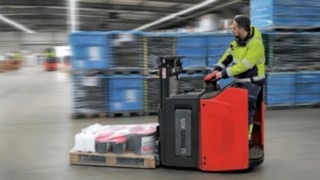
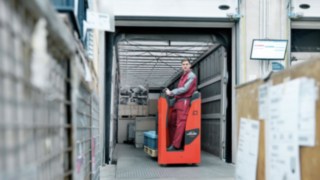
The stand-on platform and controls form a fixed unit that is decoupled from the chassis and fully sprung (even on standard models), which effectively protects the driver from vibrations and jolts. These features mean Linde trucks ensure ergonomic working conditions even during demanding tasks at loading docks. Operator comfort and productivity are increased, while health problems and higher costs resulting from long-term staff absences are avoided.
Heavy Strain on Trucks at Loading Docks
Loading docks put industrial trucks through their paces. The constant vibrations, varying surfaces, and intensive, continuous use place maximum stress on the frame, chassis, and power unit. If the wrong device is used (for example, one with a drive wheel positioned on the side), there’s a risk of rapid wear and frequent breakdowns.
For this reason, trucks that have been designed for loading and unloading trucks as well as ramps should be deployed. Linde MH has equipped its pallet trucks with special technical features that ensure optimal traction and stability to significantly reduce the strain on the trucks when traveling on loading ramps.
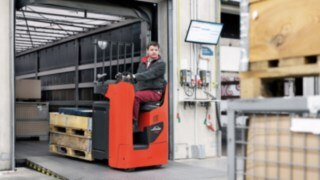
3-Point Support
The centrally positioned drive wheel provides maximum grip, while mechanical suspension ensures that all wheels remain in contact with the ground at all times to guarantee maximum stability. The 3-point support is primarily a feature on pallet trucks.
5-Point Support
This hydraulic castor wheel system is an advanced version of the 3-point support and provides additional stability, especially when driving up ramps at an angle. The 5-point support is available as an option on Linde MH’s double-deck pallet stackers and SP/AP models.
Initial Lift
In addition, all Linde forklift trucks that can be used to load and unload trucks are equipped with an initial lift, which increases the clearance between the ground and the forklift, making it easier to transport goods up ramps and preventing damage to the cargo.
Time Pressure During Loading and Unloading
Every second counts when goods are received and shipped. To load and unload trucks as quickly as possible and avoid delays in the logistics chain, Linde MH’s pallet trucks, pallet stackers, double-deck pallet stackers, and counterbalanced forklift trucks are equipped with numerous features designed to maximize handling capacity.
-
High Performance
-
Handling Precision
-
Operating Comfort
-
Speed Zones
-
Speed Management
-
Linde Curve Assist
High Performance
Special high-performance models (available with both folding and fixed stand-on platforms) enable trucks to be loaded and unloaded particularly fast thanks to their high travel and lifting speeds.
Linde MH’s counterbalanced forklift trucks are also designed for maximum throughput, with high speeds of up to 20 km/h and above-average lifting and lowering speeds keeping loading and unloading cycles short.
Handling Precision
The Linde OptiLift mast control guarantees high-precision lifting and lowering.
Operating Comfort
The electric power steering, which comes as standard on some trucks, allows for effortless and quick maneuvering. The travel speed and steering resistance adjust automatically and continuously in response to the steering angle, which facilitates smooth and fast operation.
Speed Zones
Zone-based speed reduction intelligently adjusts the speed in crowded loading zones, ensuring that accidents are avoided in these sensitive areas too.
Speed Management
If desired, double-deck pallet stackers can be equipped with an assistance system that automatically adapts the driving speed and acceleration to the lifting height, load weight, and steering angle. This makes optimal use of the truck’s performance without compromising safety.
Linde Curve Assist
The Linde Curve Assist safety system automatically adjusts the speed when cornering based on the steering angle, resulting in a consistently high handling speed with maximum control.
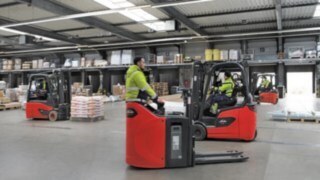
Loading Dock Safety: High Traffic Levels in a Tight Space
-
Steel Apron
-
Panoramic View
-
Ease of Use
-
Feet Detection
-
Emergency Shutdown
-
Light Options
-
Safety Zones
-
Safe Reversing
Steel Apron
The SP models have a fixed stand-on platform with a solid steel apron that extends behind the driver’s back almost to the center of the truck. This unique design provides effective protection in the event of a collision while also preventing the driver from being thrown from the truck when maneuvering at speed.
Panoramic View
In the SP models, drivers stand at a 45-degree angle to the direction of travel, allowing them to effortlessly keep an eye on their surroundings in all directions without putting excessive strain on their back and neck. Even when reversing they can maintain an ergonomic posture.
Linde MH’s counterbalanced forklift trucks are also specifically designed to permit good visibility of the work area. Narrow mast profiles, overhead tilt cylinders, and a low front plate ensure nothing blocks the driver’s line of sight. The Roadster models of the Xi series go one step further. With no A-pillar at all, the driver has a clear view when entering trucks and containers.
Ease of Use
For added user convenience, the SP models feature the innovative Linde e-driver operating concept. All controls are integrated into the control unit, which is optimized for the 45-degree position and can be operated effortlessly with one hand. On counterbalanced forklift trucks, the Linde Steer Control option can replace the classic steering wheel with a mini-wheel or a joystick. This noticeably reduces the physical strain on the driver while also improving their view of the fork tips.
Feet Detection
The Linde Feet Detection assistance system provides additional safety while driving. As soon as the driver’s feet leave the stand-on platform, the truck slows down or comes to a complete stop.
Emergency Shutdown
On trucks with a driver platform, the electromagnetic brake engages automatically as soon as the driver leaves the platform. Pressing the emergency stop switch also causes the truck to come to an immediate stop.
Light Options
Many Linde trucks can be equipped with the Linde BlueSpot if desired. This projects a blue light spot onto the ground in front of the approaching truck, which improves safety, especially in situations with limited visibility.
Safety Zones
The Linde Safety Guard is an innovative assistance system that enhances safety through customizable warning zones and precise alerts. Drivers and pedestrians are warned early, effectively preventing accidents and damage.
Safe Reversing
To help prevent accidents while backing up, Linde MH has two intelligent assistance systems. The Linde Reverse Assist Camera uses artificial intelligence to detect people behind the forklift and warn the driver in good time. The Linde Reverse Assist Radar detects objects and obstacles and actively slows the truck down to a stop if a collision is imminent—a reliable safety feature that even performs well when visibility is poor.
Optimal Use of Space in the Truck Loading Area
Maximizing the loading capacity plays a key role in ensuring cost-effectiveness in transportation, which is why it is crucial to make optimal use of the available space inside a truck. Every additional centimeter gained allows more pallets to be accommodated, significantly increasing the profitability of the shipment.

Double-Deck Loading
You can considerably increase a truck’s transport capacity by using double-deck swap bodies, as the second loading level makes optimal use of the available cargo space. Linde MH offers high-performance double-deck pallet stackers especially for this purpose. They are designed to load and unload goods on both levels simultaneously, which boosts throughput substantially.
Coordinating the Goods Flows
Inbound and outbound logistics are the start and end points of any warehouse management process. Once incoming goods have been received and checked, it is particularly important that they are then correctly entered into the system and that their route into the warehouse is determined. In outbound logistics, this process takes place in reverse order: the goods are delivered to the shipping area on time and removed from the system.
Precision and speed are crucial here, but it is just as important to maintain an overview of incoming and outgoing goods. Linde MH’s powerful digital solution, the Linde Warehouse Manager is the perfect tool for this.
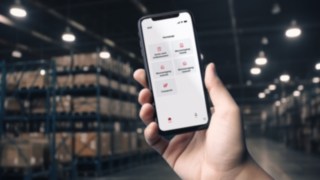
Linde Warehouse Manager
This smart warehouse management system combines all key logistics functions in one flexible solution. From goods receipt inspections and inventory management to real-time control of industrial trucks, all processes are digitalized and optimized. One particular advantage is that the modular design of the system means it can be expanded as needs arise. For example, it is possible to start with simple manual warehouse processes and then gradually integrate semi or fully automated solutions.
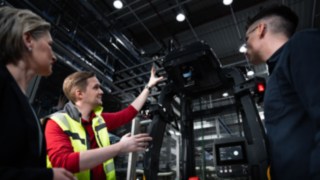
Automating Inbound and Outbound Logistics
Linde MH has a range of comprehensive automation solutions for companies looking to further optimize their inbound and outbound goods processes. From automated guided vehicles for ground transport to fully automated systems, Linde MH’s solutions can be implemented in stages and scaled flexibly to meet changing needs.
Maximize Truck Availability
Having a continuous supply of industrial trucks available in your receiving and shipping areas is essential for the smooth running of your logistics processes. In this critical area in particular, forklift outages or shortages can quickly lead to significant delays.
Waiting trucks, material backlogs, and disrupted process chains not only result in high costs, but can also affect the entire supply chain. The availability of industrial trucks must be guaranteed at all times, especially during peak times and seasonal spikes. Linde MH offers a range of sophisticated solutions to meet this need.
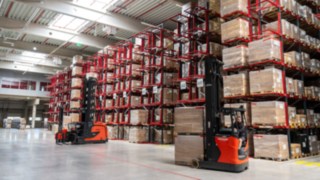
Trucks from Linde MH in Use


FAQs About Goods Received and Goods Shipped
What tasks are involved in receiving goods?
In inbound logistics, delivered goods are accepted and prepared for further processing in the warehouse. Tasks in this area include unloading the shipment and verifying it against the corresponding delivery documents. Checking the quantity and quality ensures that the delivered goods match the order and have not been damaged in transit. Labeling the goods makes them uniquely identifiable in the warehouse, and entering them into the warehouse system adds them to the available inventory. A clear division of responsibilities in the receiving department forms the basis for accurate inventory data throughout the warehouse.
What steps are involved in inbound logistics at the warehouse?
The process flow in inbound logistics is divided into several consecutive steps. The first step is to accept the delivery. In the next step, the quantity and condition of the goods are checked and compared with the purchase order and the corresponding shipping documents. If the goods require a further quality inspection, they are temporarily transferred to a holding area until the inspection is complete. The goods are then entered into the warehouse system and the inventory is updated before they are finally put away in the designated storage location or made available for downstream processes. A clearly structured goods receipt process ensures accurate inventory data, and reduces errors and complaints.
How can the goods receipt process be digitalized?
The digitalization of goods receipt replaces paper-based processes with the use of mobile scanners, apps, and enterprise resource planning (ERP) or warehouse management systems (WMS) . Delivery notes and products are recorded via barcode scanning; the data is processed digitally and synchronized with the warehouse system in real time. This allows incoming goods to be checked straightaway, inventory levels to be updated automatically, and all processes to be documented comprehensively. A digital goods receipt process reduces sources of error, speeds up workflows, and increases transparency throughout the entire warehouse chain.
What is the process for outbound logistics in the warehouse?
The outbound logistics process begins with verifying that the customer order is complete and that the items are in stock. This is followed by order picking, which is when the required goods are retrieved from the storage locations using suitable industrial trucks. The picked items are securely packaged for transport and prepared for shipment.
After the outgoing goods inspection to check the quantity, condition, and compliance with the order, the goods are loaded at the loading dock or handed over to the transport service provider. Finally, the goods issue is posted in the warehouse system, for example, using a digital solution such as the Linde Warehouse Manager . This ensures that inventory levels are automatically updated and the flow of goods is managed transparently.
How can the goods receipt process be optimized?
An efficient goods receipt process is based on standardized, end-to-end processes, from delivery to storage. Digital solutions such as scanners, apps, and ERP and warehouse management systems are good solutions for those looking to optimize their approach, as data can be captured seamlessly and automatically, and inventory managed in real time.
Optimized loading dock operations and the targeted use of appropriate industrial trucks are other ways to optimize processes in the receiving area. They reduce throughput times and ensure ergonomic and safe workflows.
What automation options are available for inbound and outbound logistics?
In inbound logistics, automated DWS and identification processes enable the dimensions, weight, and identification data of the goods to be captured quickly. Automated volume measurement and automated cargo measurement at the receiving area ensure data is accurate right from check-in. Seamless integration with ERP and WMS systems, as well as the use of integrated intralogistics solutions—such as industrial trucks, sensors, and assistance systems from Linde Material Handling—improve data quality and make check-in processes more efficient.
In outbound logistics, WMS-supported processes, camera systems, RFID, and conveyor technology support automated order picking, palletizing, and loading control. Intelligently integrating the material flow, trucks, and software to form an automated intralogistics solution helps reduce lead times and ensure the reliability of shipping processes. The result is shorter turnaround times, streamlined shipping processes, and a consistently high order quality.
How is data collected when receiving and shipping goods?
Nowadays, data entry for incoming goods is predominantly automated. Upon arrival, goods are identified using barcode scanners, mobile data recorders, or camera-based systems. Item numbers, quantities, weights, and serial numbers are transferred directly to ERP and WMS systems.
In outgoing goods, item removal, pallet tracking, and loading are recorded via the warehouse management system. Networked industrial trucks with a forklift terminal transmit transactions directly from the truck. When combined with Linde Material Handling’s assistance systems and digital solutions, automatic data capture in incoming and outgoing goods areas can be integrated into the overall logistics process in an efficient, transparent, and reliable manner.