Automated Container Warehouses
S-MATIC bin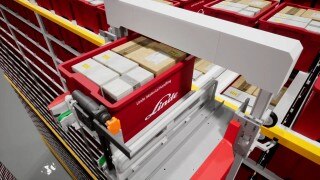
Product ranges are expanding, orders are becoming more fragmented, and customers expect their goods faster and faster. For small-item order picking, this means more picks in less time. Manual warehouses quickly run into two limitations: staffing and storage capacity. Employees often spend about half their working time walking between the shelves, and additional workers are hard to find. At the same time, space is becoming scarce: as the product range grows, the warehouse needs more storage locations, but additional space is expensive or simply unavailable. Therefore, solutions are needed that grow with demand and can be easily adapted to new requirements.
Automation can resolve both of these bottlenecks. However, traditional systems with fixed conveyor technology require high initial investments and are difficult to adapt to new requirements. The S-MATIC bin automated container storage system from Linde Material Handling offers a particularly flexible and scalable solution to these challenges.
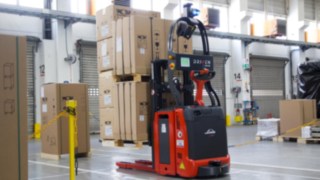
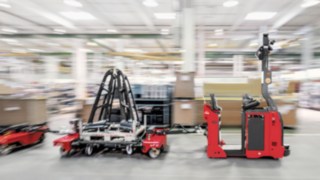
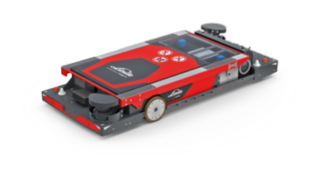
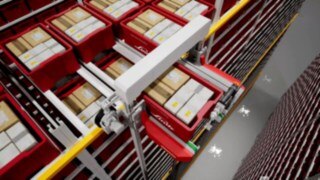
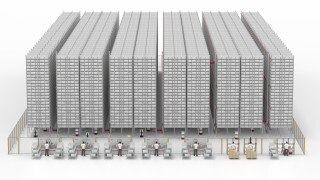
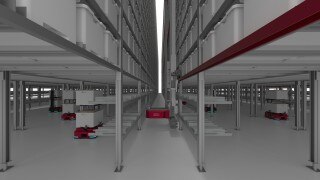
Here, the goods come to the person: Picking robots moving along the shelves retrieve containers from heights of up to 12 meters, and mobile transport robots then bring them to ergonomic picking stations. Because these transport robots handle the route to the station, no fixed conveyor system is necessary. The system makes optimal use of the available space, thereby creating many storage locations in a small area. In addition, this flexible solution can be scaled as needed and expanded with additional robots, racks, and stations.
Goods-to-Person: How the Automated Container Warehouse Works
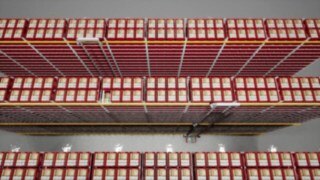
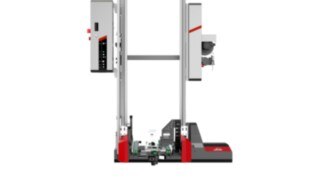
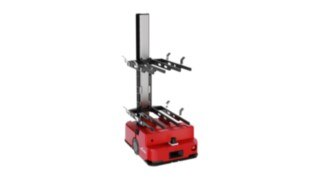
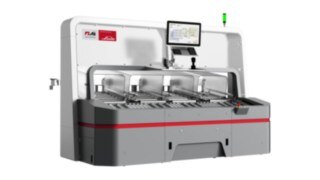
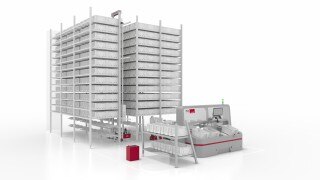
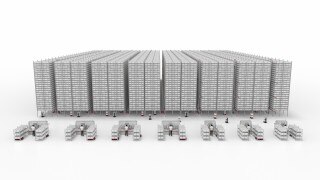
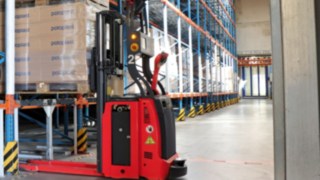
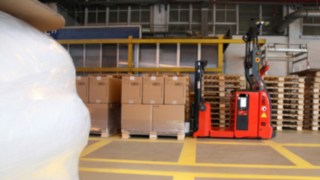
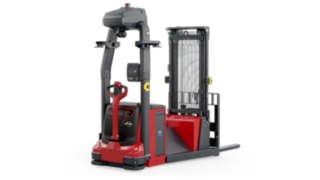
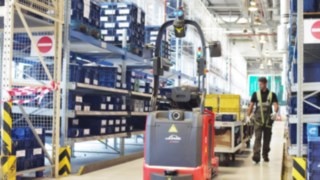
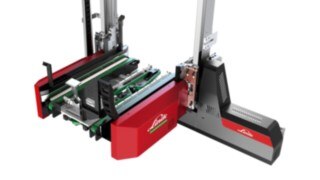
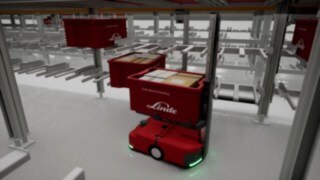
The S-MATIC bin automated container warehouse stores and retrieves goods in containers or boxes and delivers them to picking stations. Two robots work hand in hand to accomplish this: The rail-guided picking robot moves along the rack, ascends to the correct bin, and retrieves the container. It then places the container at the bottom of the rack, where a mobile transport robot (AMR) picks it up and takes it to the picking station.
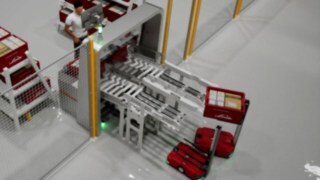
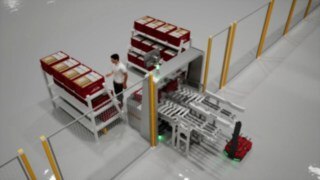
There, employees remove the required goods from the containers. After picking, the system automatically returns each container to its designated location in the warehouse. The picking stations are ergonomically designed and can be configured—depending on the process—for individual items, entire containers, or mixed operations. Mixed stations are also possible, where goods are picked from containers, shelves, and pallets.
Here's how you can benefit from the S-MATIC bin automated container storage system
Get Started on a Budget
Large, permanently installed systems with conveyor technology require extensive and complex planning. This drives up investment costs. It often takes many years for the system to pay for itself. With the S-MATIC bin, however, mobile transport robots handle the route from the shelf to the picking station, eliminating the need to install fixed conveyor technology. All that is needed are the shelf and the guide rails for the picking robot. As a result, installation is less labor-intensive, and the initial investment pays for itself more quickly than with fixed systems. Additionally, the main warehouse can be combined with a buffer warehouse for items that are needed particularly frequently. This increases capacity for these fast-moving items and can reduce the investment in picking robots by about 30 to 50 percent.
Expand step by step
With the S-MATIC bin, companies can plan for today’s needs and respond flexibly to changes. Depending on the application and process, each picking station can process between 400 and 600 order items per hour. Compared to manual picking, this can increase throughput by up to 300 percent. If the warehouse needs more capacity, additional robots and stations can simply be added. If storage space becomes limited, the rack can be expanded. The existing system grows along with the company’s needs. This makes the S-MATIC bin particularly attractive for growing or fluctuating product ranges, such as in e-commerce, spare parts logistics, or production supply.
Customize flexibly
Fixed conveyor systems remain exactly as they were originally designed. The mobile transport robots of the S-MATIC bin, on the other hand, are not tied to any fixed route: If processes change or new stations are added, their routes can be redefined with minimal effort. If necessary, the entire system can even be moved to a new location.
Easy to integrate, even into existing warehouses
The S-MATIC bin can be integrated with existing WMS or ERP systems via a standard interface. It is controlled by its own Warehouse Execution System (WES) and a Robot Control System (RCS): These systems intelligently assign tasks to the robots, dynamically allocate storage locations, and bundle orders into waves. Thanks to its streamlined design, the S-MATIC bin is also suitable for brownfield projects: It fits into existing warehouses and can be easily retrofitted there.
The S-MATIC bin at a Glance
Your Path to an Automated Container Warehouse
Every warehouse is different: product range, order structure, and available space determine what the right solution looks like. Our automation experts analyze your requirements, clarify all details, and work with you to plan the S-MATIC bin.